

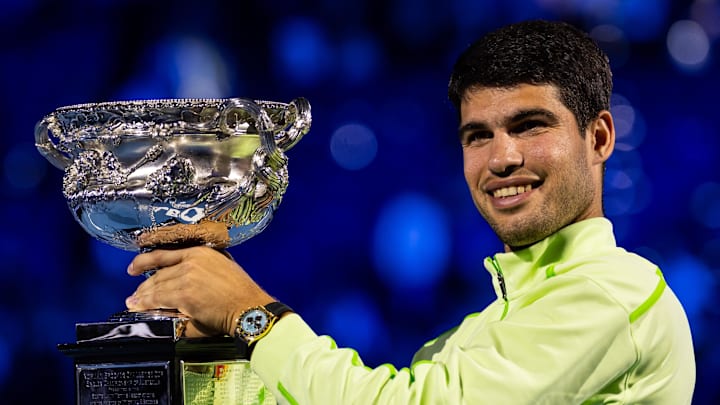
Carlos Alcaraz needed this.
Alcaraz needed to win the Australian Open on Feb. 1, which he accomplished by beating Novak Djokovic in the final in a literal matchup of the ages. Alcaraz needed to hoist the Norman Brookes Challenge Cup to become the youngest men’s player to complete the career Grand Slam.
Alcaraz also needed to claim the title in Melbourne to improve his chances of holding on to the No. 1 ranking through the first half of 2026.
Alcaraz emerged from the Australian Open with a lead of 3,350 ranking points over No. 2 Jannik Sinner in the PIF ATP Rankings. Alcaraz started the tournament with a slim advantage of 550 ranking points.
Carlos Alcaraz needed a head start in the rankings
Alcaraz needed to build a cushion. Sinner, you might recall, served three months of ineligibility from February through the first week of May last year due to an anti-doping rule violation. The gap probably cost Sinner the year-end No. 1 spot for 2025, but it will result in him making up ground in a hurry in 2026.
Sinner isn’t defending any ranking points for the next three months. Anything he does during that time will close the gap on Alcaraz.
A lead of 3,350 rankings points sounds like a lot. It’s the equivalent of winning a Grand Slam plus an ATP 1000 tournament plus reaching the final at an ATP 500 event. However, Alcaraz himself made up a difference of 3,430 ranking points between Wimbledon and the U.S. Open last year to overtake Sinner for No. 1. Alcaraz is now likely to keep No. 1 through at least the French Open, but it’s not guaranteed.
Alcaraz starts his 56th total week at No. 1. That’s the 14th-best total of all time.
Who moved up the ATP rankings during the first month of 2026?
There was a bit of shuffling among the players at the top of the rankings, but no drastic changes. The biggest rise within the top 30 was Learner Tien’s move from No. 28 to No. 24 after his run to the quarterfinals in Melbourne.
Elliot Spizzirri likely is still frustrated with how events unfolded in his third-round loss against eventual Australian Open semifinalist Sinner. Some consolation for Spizzirri: His 18-spot rise to No. 71 after reaching the round of 32 was one of the biggest jumps in the top 100.
Who moved down
Joao Fonseca’s ascendancy came to a screeching halt. Fonseca, still just 19, was on the verge of cracking the top 20 after a strong finish to 2025, but he dropped 10 spots to No. 34 after losing in the first round in Australia.
Who’s about to rise
No. 9 Ben Shelton and No. 10 Alexander Bublik don’t have many ranking points to defend in the next two months. A big run at a big event would vault either player into the top five.
Who could fall
Pity current No. 13 Jack Draper, who is defending half of his ranking points during the post-Australia hard-court season and could drop out of the top 30 without an immediate return to good health and good form. Current No. 16 Jakub Mensik also faces a swift fall if he makes an early exit in Miami, where he is the defending champion.
22 years ago this happened
This week in 2004, fresh off of his first Australian Open title, Roger Federer ascended to No. 1 in the world for the first time. Federer held the top spot for the next 237 weeks. That’s by far still the record for most weeks in a row at No. 1.
 Add us as a preferred source on Google