

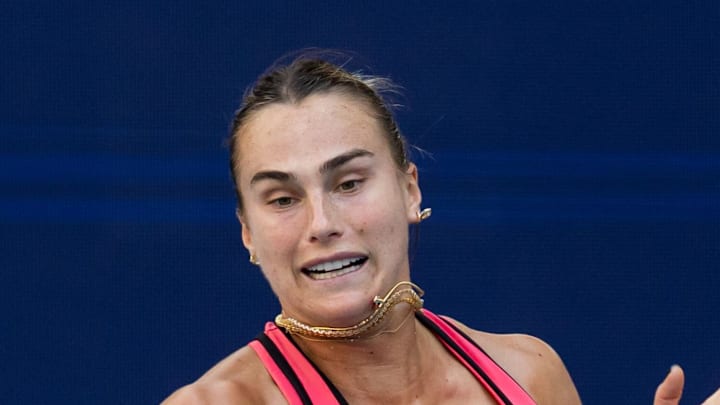
Aryna Sabalenka’s resume is shaping into of the best of the WTA’s computer rankings era.
Sabalenka is poised to extend her run as the No. 1 player in the PIF WTA Rankings after becoming just the fifth women’s player to achieve the Sunshine Double. Sabalenka won the WTA 1000 event at Indian Wells in early March and then defended her title at the WTA 1000 event in Miami this past weekend.
Sabalenka now has a lead of about 3,000 ranking points over No. 2 Elena Rybakina. That’s the equivalent of a Grand Slam title plus a win at a WTA 1000 event. Sabalenka is starting her 84th week at No. 1, the 11th-best total of all time.
Aryna Sabalenka won the Miami Open, but who else was a mover after the tournament?
Sabalenka should pass Lindsay Davenport for 10th place on the “most weeks at No. 1” list later this year. Sabalenka also needs just one more major title – it would be her fifth - to pull into a tie for 10th-most majors won since the start of the WTA computer rankings in 1975.
She’s not quite there yet. But by the end of 2026, Sabalenka could have a solid claim as one of the 10 best players of the past 50 years.
Who moved up the WTA rankings during the spring hard-court season?
Victoria Mboko moved up four spots since the end of the Australian Open to make her top 10 debut at No. 9. Mboko had three solid results at WTA 1000 hard court events – a final in Doha plus quarterfinal runs at Indian Wells and Miami.
The biggest movers in the top 100 earned their new rankings the hard way. Sara Bejlek, a 20-year-old from Czechia, was No. 101 after the Australian Open. She’s now No. 40 after winning the WTA 500 event in Abu Dhabi as a qualifier.
Twenty-one-year-old Aussie Talia Gibson, who doesn’t even have her own photo on the WTA rankings listing, has moved from No. 118 to No. 56 after coming through qualifying to reach the quarterfinals at Indian Wells and the round of 16 in Miami.
Who moved down?
Emma Navarro hasn’t won a tour-level match since mid-February and withdrew from the Miami and Charleston events, citing health struggles. Her ranking has slipped from No. 17 at the end of the Australian Open to No. 25 heading into the clay-court season.
Who’s about to rise?
Current No. 45 Alexandra Eala, who has yo-yoed up and down the rankings since the end of the Australian Open, is positioned to make her many fans happy with a quick rise back up the rankings during clay court season. Eala isn’t defending many ranking points. She showed clay court mettle by taking none other than Iga Swiatek to three sets on the surface in Madrid last spring.
Who could fall?
Current No. 30 Zheng Qinwen, who has been plagued by injuries for more than a year, could fall all the way out of the top 100 without a few solid results. Current No. 39 Lois Boisson, the darling of Paris last spring with a surprise run to the French Open semifinals, also could drop out of the top 100 with a spring slump.
29 years ago this happened
This week in 1997, Martina Hingis supplanted Steffi Graf atop the WTA rankings, a moment that still reverberates in the women’s tennis record book. Hingis was 16 years and 182 days old and is still the youngest player to reach No. 1 in the WTA rankings.
Graf never returned to No. 1 in the rankings, so her record for total weeks at No. 1 ended at 377. Hingis was just the eighth player to reach No. 1 in the WTA rankings. She held the top spot for the next 80 weeks.
 Add us as a preferred source on Google