

Will the first Grand Slam of the 2026 tennis season produce a surprise men’s champion?
The odds are against it – and not just because top-ranked Carlos Alcaraz and two-time defending champion Jannik Sinner are heavy favorites as the 2026 Australian Open gets underway.
There have been 97 Australian champions since the tournament began seeding the field in 1924. All but nine of the winners Down Under have been top-five seeds. There has been just one unseeded champion. Only three players have hoisted the Norman Brookes Challenge Cup as a double-digit seed.
The most surprising Australian Open men’s champions
Learn more about the players who defied the odds and became the five most unexpected champions in Australian Open history.
Honorable mention: Surprises who weren’t surprises
The worst seed to win an Australian Open this century? None other than Roger Federer, who entered the 2017 Australian Open as the No. 17 seed after missing the final months of 2016 to fully recover from knee surgery. Federer overcame his great rival Rafael Nadal in a five-set final to claim his first major in five years.
Yevgeny Kafelnikov, the 1999 champion, technically was the only double-digit seed to win the Australian during the 1900s, but his triumph wasn’t a huge surprise. Kafelnikov had won the French Open three years earlier and was No. 1 in the world by May of 1999.
#5 - Petr Korda (1998)
Korda was 30 when he won the 1998 Australian Open as the No. 6 seed, numbers that made his lone Grand Slam title all the more unexpected at the time.
Players rarely won Grand Slams after turning 30 in that era. Korda in 1998 was the first 30-something to win a major in eight years. Just two previous players had won the Australian Open without the benefit of a top-five seed. Korda became the third.
Korda benefited from Karol Kucera’s quarterfinal upset of defending champion and top seed Pete Sampras. Korda, in turn, beat Kucera in the semifinal and then thrashed future world No. 1 Marcelo Rios in a lefty-vs.-lefty final.
In a bizarre postscript, Korda’s playing career went into a tailspin later in 1998 in the aftermath of a failed drug test. (If there was a list of “five most surprising athletes to test positive for steroid use,” the 6-3, 190-pound Korda would make the list). Rios in 2015 argued that Korda should be stripped of the 1998 Aussie title, but no action was taken.
Korda is better known to younger fans as the father of American pro Sebastian Korda and LPGA golfers Nelly and Jessica Korda.
#4 – Stan Wawrinka (2014)
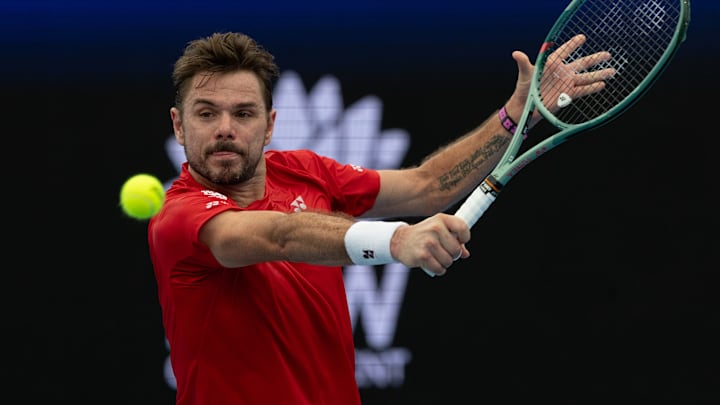
The Stanimal, who is retiring this year, won the title as the No. 8 seed. Some might not regard this as a surprise – Wawrinka went on to bag three career majors – but these were the factors working against him in 2014:
- Wawrinka had yet to reach a Slam final, much less win one.
- The Big Four – Roger Federer, Rafael Nadal, Novak Djokovic, and Andy Murray – had won all but one major since the 2005 French Open.
- No player had beaten the top two seeds to win a Slam in 21 years. Wawrinka took out No. 2 seed and three-time defending champion Djokovic by a 9-7 score in the fifth in the quarterfinals – a result that looks more impressive now given Djokovic’s eventual record in Australia – to earn a shot at top seed Nadal in the final.
- All signs favored Nadal entering the final. No player had ever beaten Djokovic and Nadal in the same major. Wawrinka had lost all 12 of his past meetings against Nadal without winning a set. And Nadal looked invincible in a three-set win against Federer in the semifinal.
Wawrinka brushed aside all that history in the final. Wawrinka outslugged Nadal in the first set. He held his nerve when Nadal was hobbled by a back injury and closed out the match in four sets.
#3 – Brian Teacher (1980)
Yes, this was an era of weak fields in Australia. Nonetheless, Teacher taking the title as the No. 8 seed in a field that included past Slam winners Guillermo Vilas and Vitas Gerulaitis, plus future major winners Ivan Lendl and Yannick Noah, still counts as a surprise.
Round after round, the draw opened up for Teacher. He didn’t face any opponent seeded better than 12th, and he made the most of the opportunity.
Teacher took advantage of a tired opponent in the final. Kim Warwick took out two-time defending champion Vilas in a five-set semifinal, but had little left for Teacher, who won the championship match in three sets.
Teacher later revealed that he briefly withdrew from the event when his then-wife informed him she wanted a divorce on the eve of the tournament. Teacher stayed Down Under only after a call from his then-father-in-law and only after another player withdrew, re-opening a spot in the draw.
#2 – Thomas Johansson (2002)
It was clear within a few days that the 2002 Australian Open would have a surprise winner. Two-time defending champion and No. 3 seed Andre Agassi withdrew due to injury before the event began. The top two seeds, Lleyton Hewitt and Gustavo Kuerten, lost in the first round.
The No. 4 and No. 5 seeds were out by the end of the second round. Just one of the top eight seeds made the quarterfinals. Only one of the last eight – 2000 U.S. Open champion Marat Safin – had won a major title.
Even after all of the upsets, few expected Thomas Johansson to emerge as the champion. Johansson was the solid but unspectacular No. 16 seed who had put together a solid but unspectacular career.
Most assumed the semifinal between Safin and No. 7 seed Tommy Haas was the “real” final. When Safin prevailed against Haas in five sets, most assumed the Russian star would make short work of Johansson, who needed five sets to get past Jiri Novak in the other semi to claim his second major. The final event fell on Safin’s birthday.
Surprise! Johansson gradually outplayed Safin after dropping the opening set and swept the last three sets to become the most unlikely Australian champion of the 2000s.
#1 – Mark Edmondson (1976)
He’s the answer to the trivia question. Edmondson was ranked No. 212 in the world when he won the Australian Open in 1976. He’s still the lowest-ranked player to claim a major title.
Yes, this was a depleted field. Ken Rosewall, who had just celebrated his 41st birthday, was the No. 1 seed. Other top seeds like John Newcombe, Tony Roche, and Stan Smith were past their primes. None of the top players outside of Australia or the United States bothered to make the trip.
Even taking those things into account, Edmondson’s victory was still a shock. Despite the weak field, Edmondson was one of the last players granted entry into the draw. Edmondson’s win under those circumstances would be like a player ranked No. 212 winning an ATP 250 event today.
For perspective, Valentin Vacherot – the lowest-ranked player to win an ATP Masters 1000 event - was ranked No. 203 when he won the Shanghai Masters this past fall. That’s nine spots better than Edmondson’s 1976 ranking.
Oddly enough, Edmondson’s toughest test was in the first round of his only match against an unseeded opponent. Edmondson needed five sets to get past Peter Feigl from Austria.
He cleared his own path to the late stages of the tournament with a victory against No. 5 seed Phil Dent in Round 2. He took out Rosewall in the semifinals and defending champion Newcombe in the final to etch his name permanently on the list of unlikely Grand Slam winners.
 Add us as a preferred source on Google