

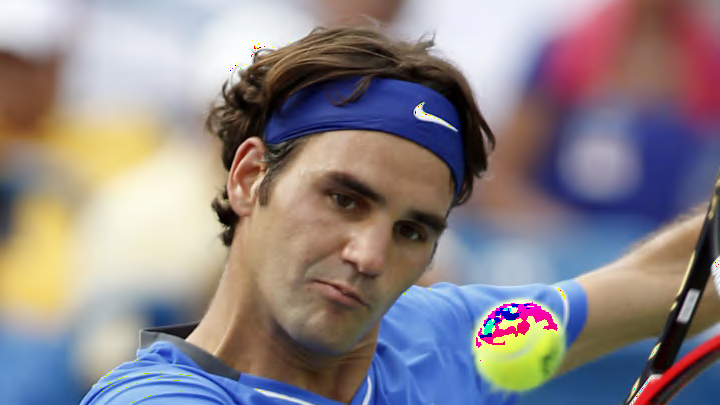
Roger Federer was three points away from being the greatest of all time. Still, he likely reigns supreme in a tennis universe where the players who saved match points on their way to winning Grand Slams didn’t.
Forty-eight times in tennis history, players won majors despite facing a match point sometime during the tournament. What would tennis history look like if all those players lost all those matches?
For starters, Federer would have the most men’s major titles in this revised version of tennis history. We’d have a tie for most women’s majors. Jannik Sinner, not Carlos Alcaraz, would be the young player on track to shatter records.
Greatest of all time status for Roger Federer
You’d be shocked to see who we’d remember as the best women’s clay court player of the early 2000s. That’s just a few of the big changes to the tennis records books if the players who saved match points to win majors all lost.
Poor Federer is the only player in tennis history to hold a match point against the player destined to win that major on three different occasions. The most memorable was Wimbledon in 2019, when Federer couldn’t convert two match points on his own serve at 8-7 in the fifth set against Novak Djokovic.
Federer also failed to convert two match points in the fifth set in the semifinals against eventual winner Djokovic at the 2011 U.S. Open. A similar fate befell Federer in the 2005 Australian Open semifinals, when a between-the-legs shot on match point backfired, and Marat Safin went on to win their match and the tournament.
If Federer wins those matches and goes on to win all three tournaments, he retires with 23 majors – the most in men’s tennis history. Two of those majors would have been at Djokovic’s expense, so Djokovic’s total drops from his current men’s record of 24 to 22.
(Or does it? Stan Wawrinka, who beat Djokovic in the 2016 U.S. Open final, had to save a match point along the way against Dan Evans in the third round. If Wawrinka hadn’t gotten past the first week in New York, would Djokovic have won the final, likely against Kei Nishikori?)
Other notable changes in this version of men’s tennis history:
- Bill Tilden adds a French title to his collection of U.S. and Wimbledon championships. He had two match points in the 1927 French final against Rene LaCoste.
- Michael Chang reaches No. 1 in the world after all. If Pete Sampras hadn’t survived match point (and on-court illness) against Alex Corretja in the 1996 U.S. Open quarterfinal, Chang probably would have won the event and finished 1996 as the year-end No. 1.
- Andy Roddick never won a slam and never reached No. 1. Roddick had to save three match points against David Nalbandian in the 2003 U.S. Open semifinals. That was the only major title Roddick ever won and the key result in his 2003 year-end No. 1 finish. Juan Carlos Ferrero likely wins the U.S. Open and finishes 2003 at the top spot.
- Jannik Sinner leads Carlos Alcaraz six majors to five in the race to be the top player of the 2020s. Improbably, Alcaraz has already saved match points against Sinner en route to winning two majors – in the 2022 U.S. Open quarterfinals and, more memorably, in the 2025 French Open final.
- There’s a chance we’ve never had a men’s calendar-year Grand Slam. Don Budge held two match points against Fred Perry in the 1936 U.S. final. If Budge wins that match, does he turn pro before he can complete the first calendar year Slam? In 1962, Rod Laver had to save a match point in the French quarterfinals against Marty Mulligan en route to his first calendar-year Slam. If Laver doesn’t complete the Slam in 1962, does he achieve the feat in 1969?
Steffi Graf and Margaret Court are fit to be tied
In this revised timeline, Margaret Court and Steffi Graf are tied for the most women’s majors with 23 apiece. (Court actually finished with 24, Graf with 22). Court had to save a match point in her 1962 French final against Lesley Turner.
Graf had three match points go against her in her 1986 U.S. Open semifinal loss against eventual champion Martina Navratilova. Reverse those two results, and you get a tie atop the women’s major titles standings.
What about Serena Williams? Serena is the “reverse Federer” of the women’s game. She’s won majors despite facing match point along the way a record three times. Take away those three titles – the 2003 Australian Open, the 2005 Australian Open, and Wimbledon in 2009 – and Serena finishes with “only” 20 major titles.
(Or does she? Williams lost in the 2016 Australian Open final against Angelique Kerber and the 2021 Australian Open semifinals against Naomi Osaka. Both Kerber and Osaka saved match points early in their tournament runs. If Kerber and Osaka hadn’t been in the way, would Williams have added two more Aussie titles to her Grand Slam tally?)
The notable changes in this version of women's tennis history are two-fold. The first is that Svetlana Kuznetsova might be remembered as the Queen of Clay from the first decade of the 2000s. She held match point in fourth-round matches against the eventual champion at the French Open in back-to-back years – against Anastasia Myskina in 2004 and Justine Henin in 2005.
If Kuznetsova goes on to win both events, she ties Henin for the most French titles between 2000 and 2009. Instead, Kuznetsova is the only women’s player with multiple losses after holding match point against the eventual winner at that Grand Slam event.
The second part is that a few players on the “best players never to win a major” list pick up Grand Slam titles. Mary Jo Fernandez definitely wins the 1991 Australian Open. She held a match point against the actual winner, Monica Seles, in the final.
Elena Dementieva would have gotten a shot to win Wimbledon in 2009. She had a match point against the actual winner, Serena Williams, in the semifinal and would have faced Venus Williams in the final.
 Add us as a preferred source on Google